What are we working on?
Untitled case
Choose the channel gap.
Compare three gaps against your pressure-drop budget, then run nine OpenFOAM solves to check the choice.
Water at nominal 20 °C · 100 mm reference width · laminar, fully developed parallel-plate flow.
Model assumptions and supported range
Length 100–500 mm; nominal gap 1–3 mm; flow 1–40 mL/s. The tested gaps are 75%, 100% and 125% of nominal. Density 998.2 kg/m³; viscosity 0.001003 Pa·s. The 2D model omits sidewall drag, entry losses, bends, fittings and heat transfer. The parabolic inlet assumes an upstream developed flow.
Analytical estimates update with your inputs. The solver comparison follows after you start the study.
Analytical reference: flow between parallel plates ↗Drag to rotate · scroll to zoom. Gap and solver slice depth shown ×20 for inspection.
Three structured grids per gap: 512, 1,152 and 2,048 cells. Every generated mesh must pass checkMesh.
3 gap variants × 3 grids, then a LaTeX PDF paper. Five-minute solve limit plus up to 90 seconds for the report.
Clicking Start sends the four numeric inputs to the solver. Evidence is retained for 48 hours.
One tube. Three load cases. A checked working notebook.
Ask questions on the left. Review the controlled inputs and evidence here. A model explanation cannot change these calculations or declare the tube safe.
Assumed inputs · not yet reviewed.
What would pressure and heat do to this tube?
Predict stresses in a closed-end pressure tube. Separately compare heating a sliding tube with heating one whose axial ends cannot move. Before inspecting any FEA contour, establish the expected loads, signs and scale.
Equation consistency and idealized FE verification—not exchanger design release. No real alloy allowable or test correlation has been supplied.
Review the physics before the answer.
All values are synthetic assumptions. Constant isotropic elasticity; uniform temperature; transverse surfaces traction-free in the thermal cases. Outside gauge pressure stays zero.
Apply is explicit. Draft values do not alter the working record until applied. Any applied edit removes the previous assumption review and invalidates mismatched retained FE evidence.
Derive, then substitute.
Compatibility and equilibrium determine the pressure field. Pressure tractions determine A and B. Closed-end thrust sets axial stress. Thermal boundary conditions decide whether expansion or compression results.
Compatibility and radial equilibrium
View LaTeX source
\epsilon_r=u_r',\quad\epsilon_\theta=\frac{u_r}{r},\quad\epsilon_z=\mathrm{const},\qquad \frac{d\sigma_r}{dr}+\frac{\sigma_r-\sigma_\theta}{r}=0Long isotropic elastic tube, away from end effects. Tension is positive.
Pressure boundary-value solution
View LaTeX source
A=\frac{p_i a^2-p_o b^2}{b^2-a^2},\quad B=\frac{a^2b^2(p_i-p_o)}{b^2-a^2},\qquad\sigma_r=A-\frac{B}{r^2},\quad\sigma_\theta=A+\frac{B}{r^2}Pressure-only Lamé field; radial tractions are minus gauge pressure.
Closed-end force balance and displacement
View LaTeX source
\sigma_z=A,\qquad u_r(r)=\frac{(1-2\nu)Ar+(1+\nu)B/r}{E}Closed ends with pressure thrust, not open ends or imposed plane strain.
Separate thermal-only free and restrained cases
View LaTeX source
\sigma_z=E\left(\frac{du}{dx}-\alpha\Delta T\right),\quad u_{\mathrm{free}}(L)=\alpha\Delta T L,\quad\sigma_{\mathrm{fixed}}=-E\alpha\Delta TUniform temperature; transverse surfaces traction-free. Cases are not combined with pressure.
Challenge the calculated field.
Test both pressure tractions, end-force equilibrium, radial differential equilibrium and the thermal limiting cases. These algebraic checks can expose implementation errors. They do not validate real material or model-form assumptions.
| Check | Normalized identity residual | State |
|---|
Identity-check tolerance: 10⁻¹⁰, for floating-point consistency only—not a universal engineering acceptance limit. The published Python verification also contains nine executable tests.
Compare with a different calculation—not with a confident answer.
The retained Python calculation assembles and solves a radial FE stiffness matrix plus a constant axial-strain degree of freedom. It is an educational implementation, not ANSYS or CalculiX.
FE verification, not physical validation
View LaTeX source
\mathbf K=\sum_e\int_e\mathbf B^T\mathbf D\mathbf B\,2\pi rL\,dr,\qquad\mathbf K\mathbf q=\mathbf f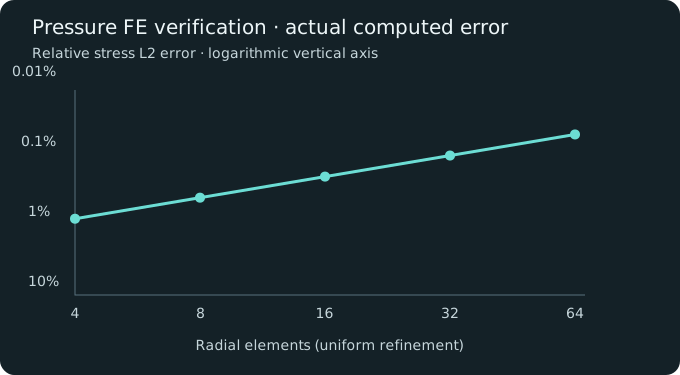
| Elements | Stress L₂ error | Outer displacement error |
|---|---|---|
| 4 | 1.3332% | 0.012724% |
| 8 | 0.6668% | 0.003182% |
| 16 | 0.3334% | 0.000796% |
| 32 | 0.1667% | 0.000199% |
| 64 | 0.0834% | 0.000050% |
Separate free/fixed thermal FE cases agree to floating-point precision. They are not combined-load exchanger qualification.
The retained numerical values only apply to the exact reference inputs. Changed inputs require a new FE calculation; this page does not silently reuse the old PASS.
A bounded conclusion. An explicit next question.
- Equation consistency
- PASS
- FE comparison for active inputs
- Retained reference only
- Assumption review
- NOT REVIEWED
- Physical validation
- NOT_ESTABLISHED
- Hardware safety
- NOT_ESTABLISHED
Next engineering action: establish the real alloy, temperature-dependent properties, allowables, actual tube-sheet restraint, load combinations and relevant failure modes. Then select and qualify the conventional model and compare with independent physical evidence. A larger model or finer mesh cannot supply missing requirements.
Export .tex downloads this evolving notebook. It is source for external compilation, not a live PDF compiler. No GPU, private agent or model connection is required for the calculations.
What does Aero need to know?
Answer each question, then confirm it.
First principles, in view.
Equations and assumptions grow from the conversation. This is rendered LaTeX—not a solver result.
No job has been started. Preparation is not execution or validation.
Open authenticated execution workspace ↗