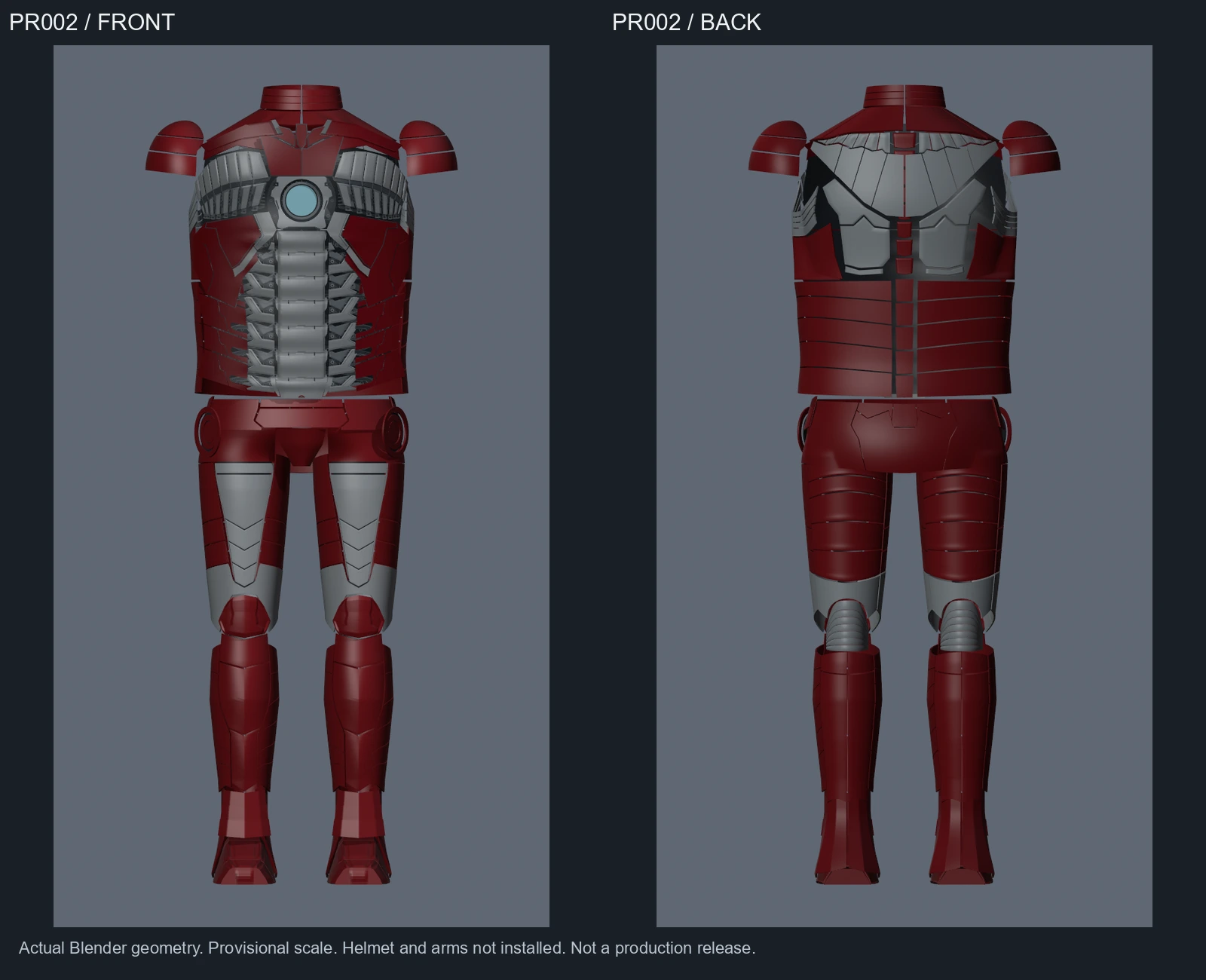
What is here
The current study brings the earlier chest together with back armor, shoulder shells, a collar, pelvis, thighs, knee covers, shins, ankles and boots. The latest pass refines the central pelvis shield and checks the previously modeled rear-knee courses.
The design target is a clean, intact Mk V: red armor, formed silver panels and layered transitions. Missing panels from battle damage are not treated as intended openings. The separate purchased motorized arm retains its creator’s mechanism and shell geometry; its Mk V treatment is cosmetic.
Reference comparison, with limits
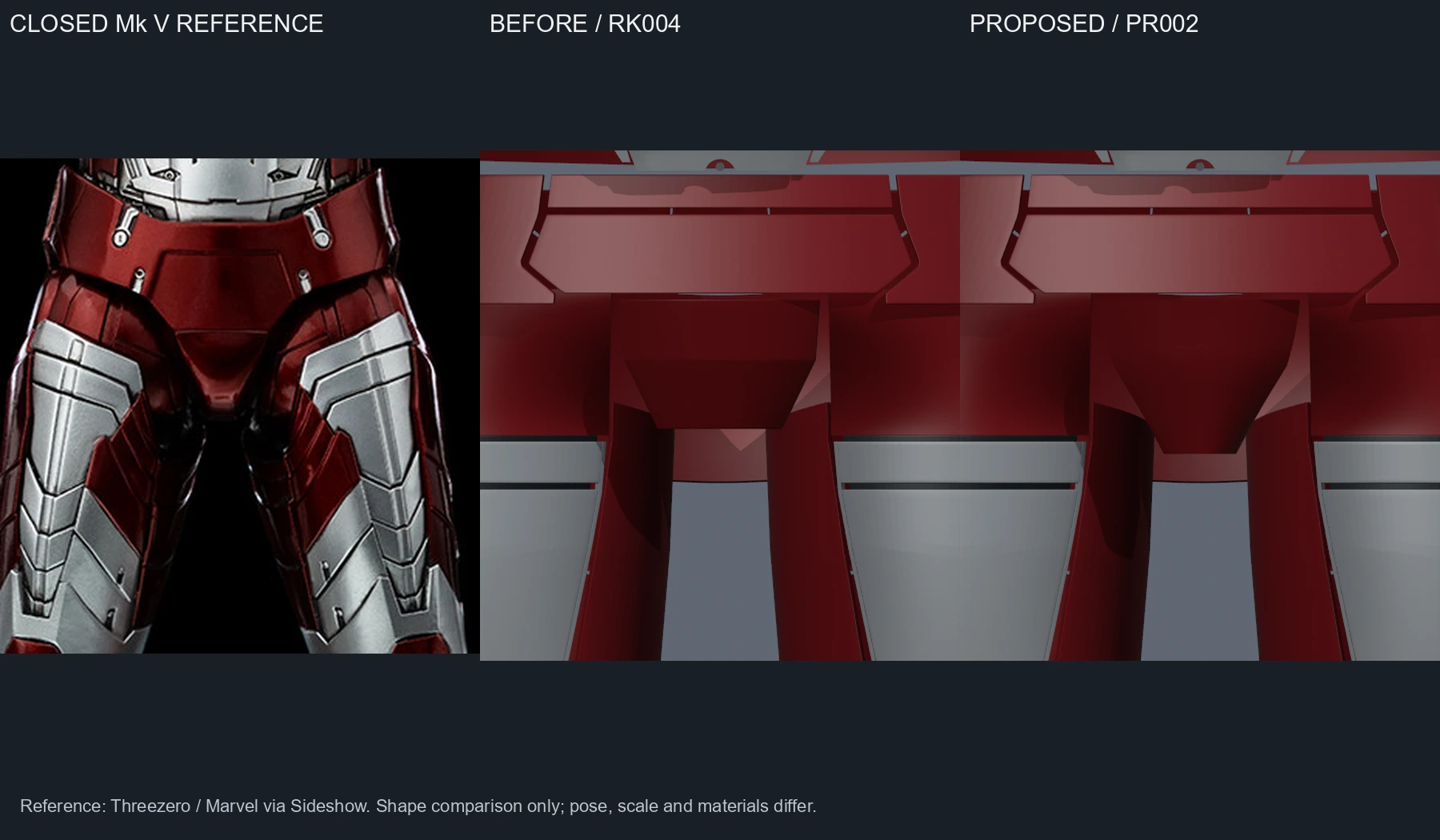
The reference supports a more tapered central shield. An initial deformation kept a preview bevel that produced unresolved self-contact candidates. The next revision removes that bevel on the new part. The comparison does not establish wearer clearance or exact movie-suit proportions.
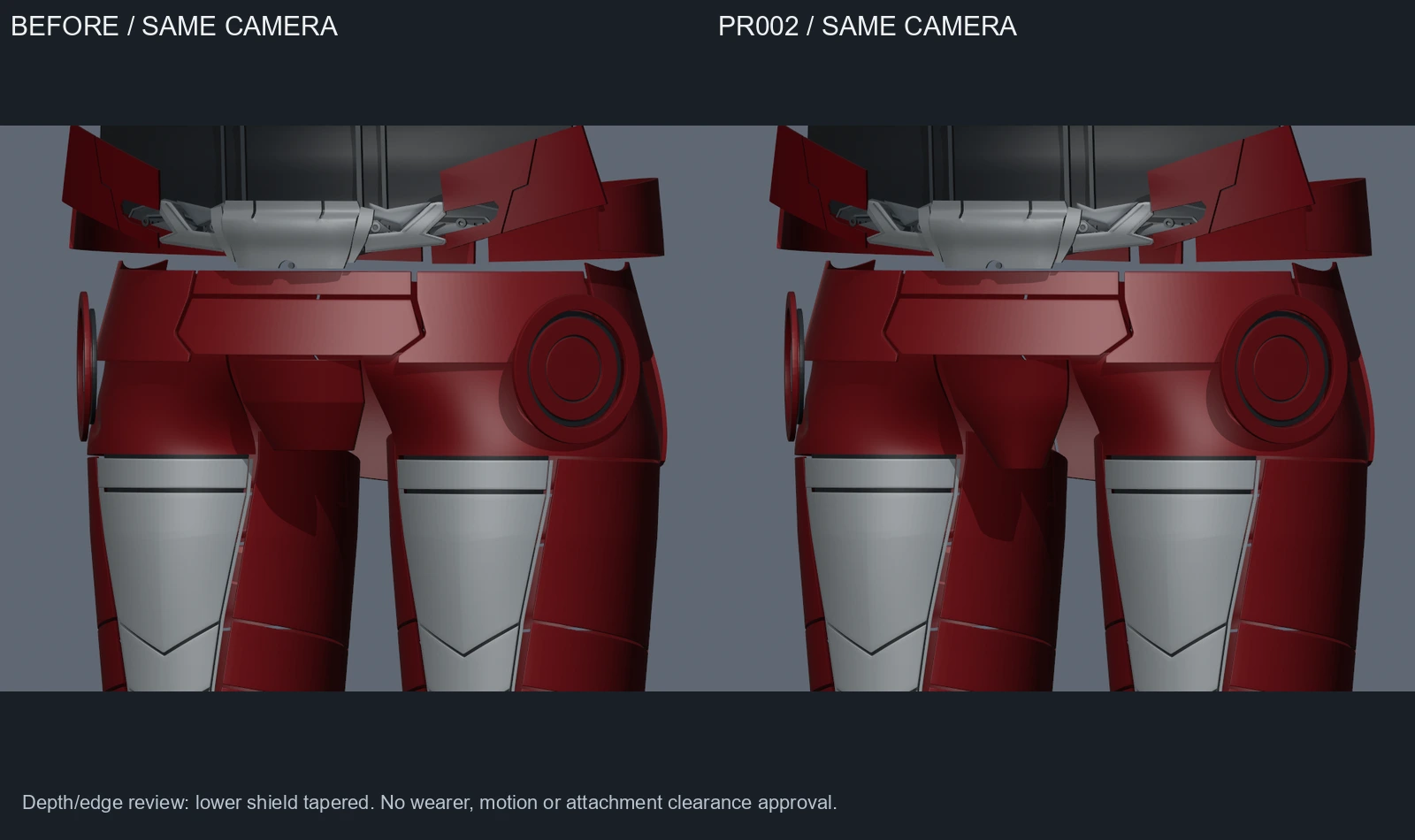
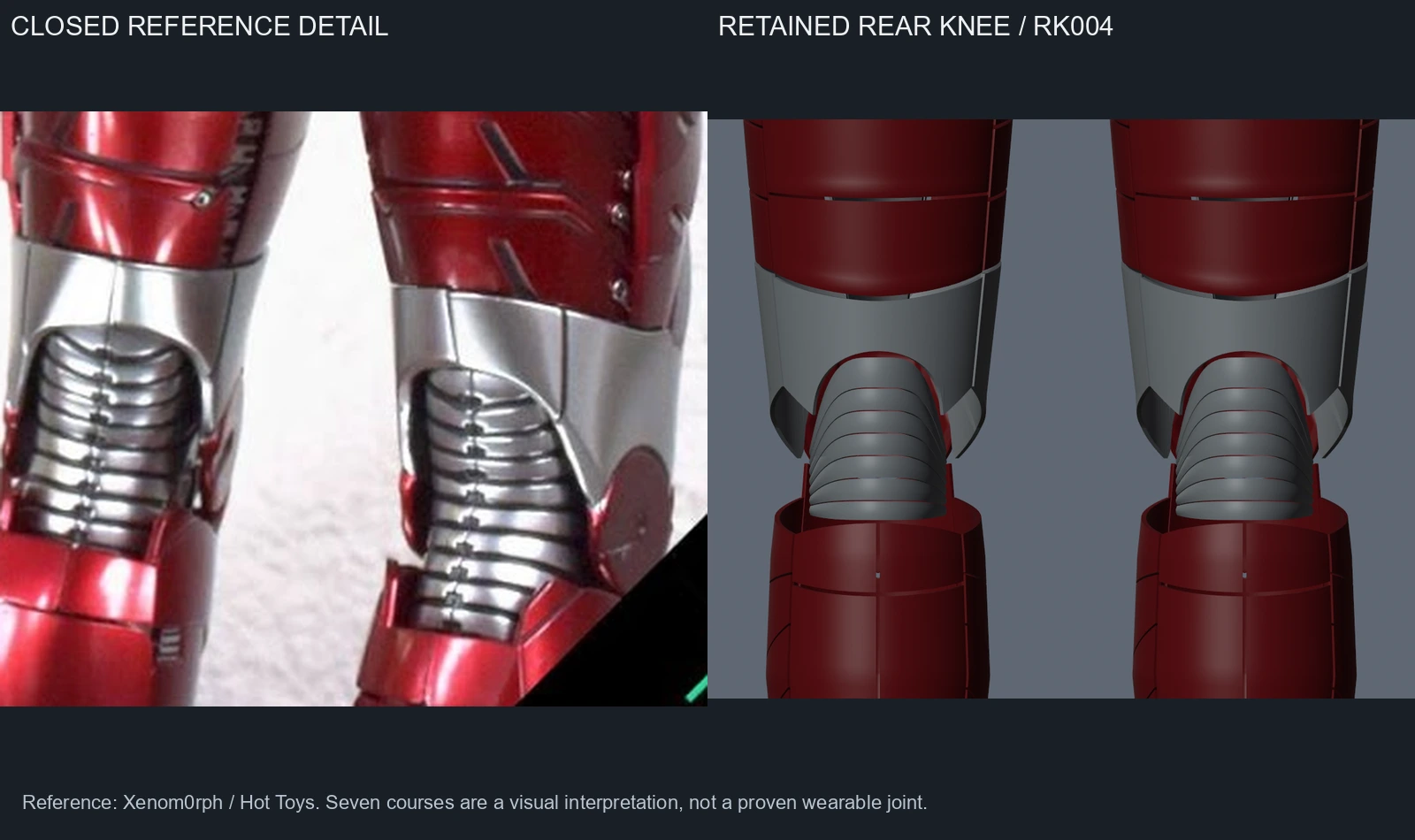
Review covered outline, oblique depth and mesh validity. The silver knee courses are static appearance geometry, not a working flexure. Heel underside detail, hidden groin clearances and hardware interfaces were deliberately not guessed from occluded photographs.
The comparisons still show a simplified collar and upper-back relief, broad provisional proportions and a less detailed rear-knee treatment. This is evidence of the current state, not a claim of a finished visual match.
Checks and unresolved work
- Visible mesh components
- 1024
- Exported prototype STL sections
- 1018
- Components withheld by mesh checks
- 8
- Section envelope target
- 340 × 340 × 340 mm, inside a nominal 350 mm K2 Plus volume
- Original master
- SHA-256 unchanged; retained separately
- Local physical wall thickness
- UNKNOWN_ESTIMATE_ONLY
- Fit / motion / attachment release
- Not approved
Exported files are checked for closed edge topology, winding, positive volume, degenerate triangles and unresolved nonadjacent self-contact candidates. Each binary STL is read back and checked again for topology. Those checks are bounded: they do not certify minimum wall thickness, all inter-part clearances, slicer support, hardware strength or safe movement.
Oversized components are divided into capped prototype sections. These have plain butt seams, not engineered fastening joints. Tiny detail meshes remain separate in the catalog; a production plan must decide which details should be combined with a carrier.
- Actual body, shoe, cooling-garment and harness dimensions are still needed.
- Helmet and purchased-arm registration, working interfaces and motion checks remain open.
- Reservoir, pump, electronics, padding and harness reservations need real hardware dimensions.
- Held components need repair or consolidation before a manufacturing release.
- STL does not preserve red/silver colors; use the Blender material assignments as the finishing guide.
Public downloads
Download the current CAD, prototype sections, validation evidence and earlier project files below. The archive index identifies historical files; earlier revisions are not promoted to current print approval.
- Current Blender CAD — PR00291.6 MB
- Current checked prototype STL sections89.8 MB
- Review renders and validation evidence7.5 MB
- Historical originals — archive 01336.0 MB
- Historical originals — archive 02338.7 MB
- Historical originals — archive 03319.9 MB
- Historical originals — archive 04330.2 MB
- Historical originals — archive 05307.5 MB
- Historical originals — archive 06345.4 MB
- Historical originals — archive 07341.8 MB
- Historical originals — archive 08273.4 MB
- Historical originals — archive 09264.2 MB
- Historical originals — archive 10266.6 MB
- Historical originals — archive 11270.1 MB
- Historical originals — archive 12274.2 MB
- Historical originals — archive 13261.8 MB
- Historical originals — archive 14261.6 MB
- Historical originals — archive 15267.5 MB
- Historical originals — archive 16333.2 MB
- Historical originals — archive 177.9 MB
File index, checksums and release scope →
Per-component export and hold report →
Independent STL and segmentation checks →
Read the prototype print guide →
Next engineering gate
Fit the shell to measured body and equipment envelopes, finish the attachment and movement architecture, then verify local walls and slice representative sections. Until then, these downloads support CAD inspection and controlled prototype tests—not a full-suit print order.