EXPERIMENTAL CFD COMPARISON · RUN 22 NOV 2026
A real experiment.
A result we can question.
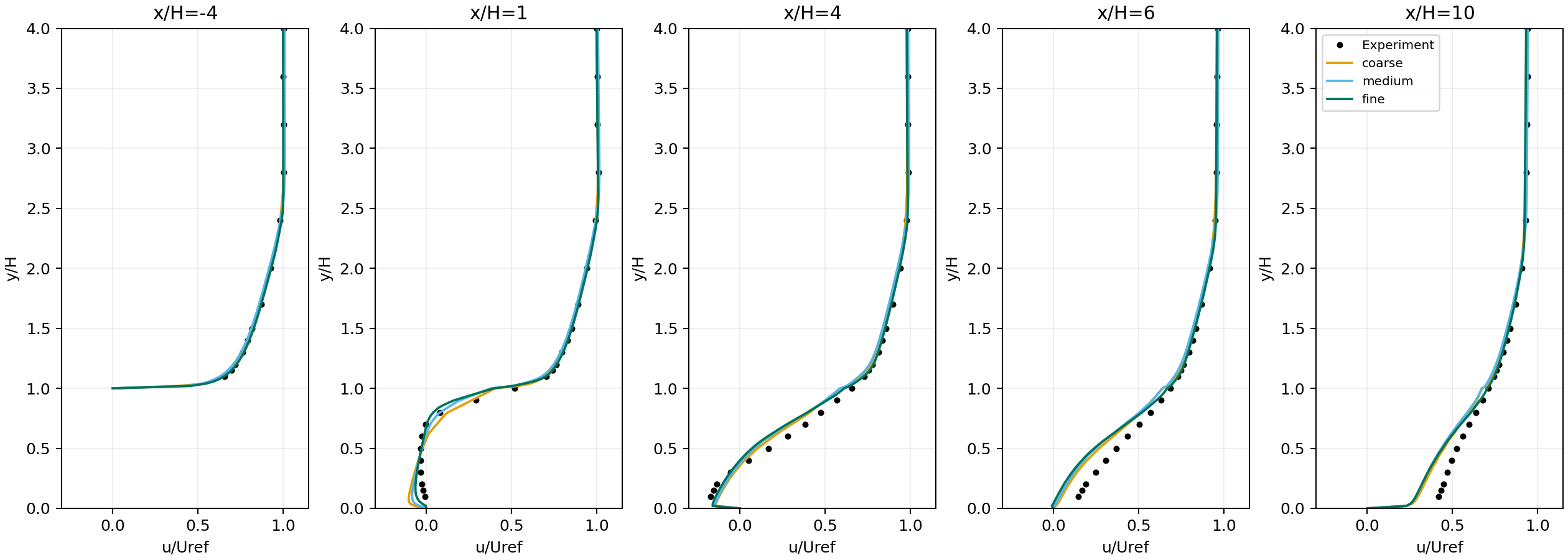
Aero’s OpenFOAM pipeline meets the Driver–Seegmiller backward-facing step: three meshes, measured velocity profiles, wall pressure and skin friction.
AI workflow assistance: OpenAI 6.1 High (owner-reported model label)
Published by Alex Blythe. The reference experiment is peer-reviewed; this Aero execution report is not. This is a retained OpenFOAM run, separate from Aero’s Excel and browser demonstrations.
MEASURED DIFFERENCES
The finest mesh, against the experiment.
| Mesh / cells | Reattachment x/H | CFD − experiment | Velocity RMSE / Uref | Initial-residual target |
|---|---|---|---|---|
| coarse / 6,800 | 6.1461 | -0.1139H · -1.82% | 4.54% | Met |
| medium / 27,200 | 6.2790 | +0.0190H · +0.30% | 5.20% | Not met |
| fine / 108,800 | 6.4405 | +0.1805H · +2.88% | 5.04% | Not met |
Fine-grid reattachment is 2.29 mm longer than measured. Medium-to-fine reattachment changes by 2.51% of the fine result. The grid increments do not establish an asymptotic trend or a defensible extrapolated uncertainty bound.
THE FAILURE PATTERN
Why did only 5 of 20 friction points agree?
Every upstream point falls inside its reported error bar. Downstream, only 2 of 17 do—and all 17 predictions fall below the measured coefficient.
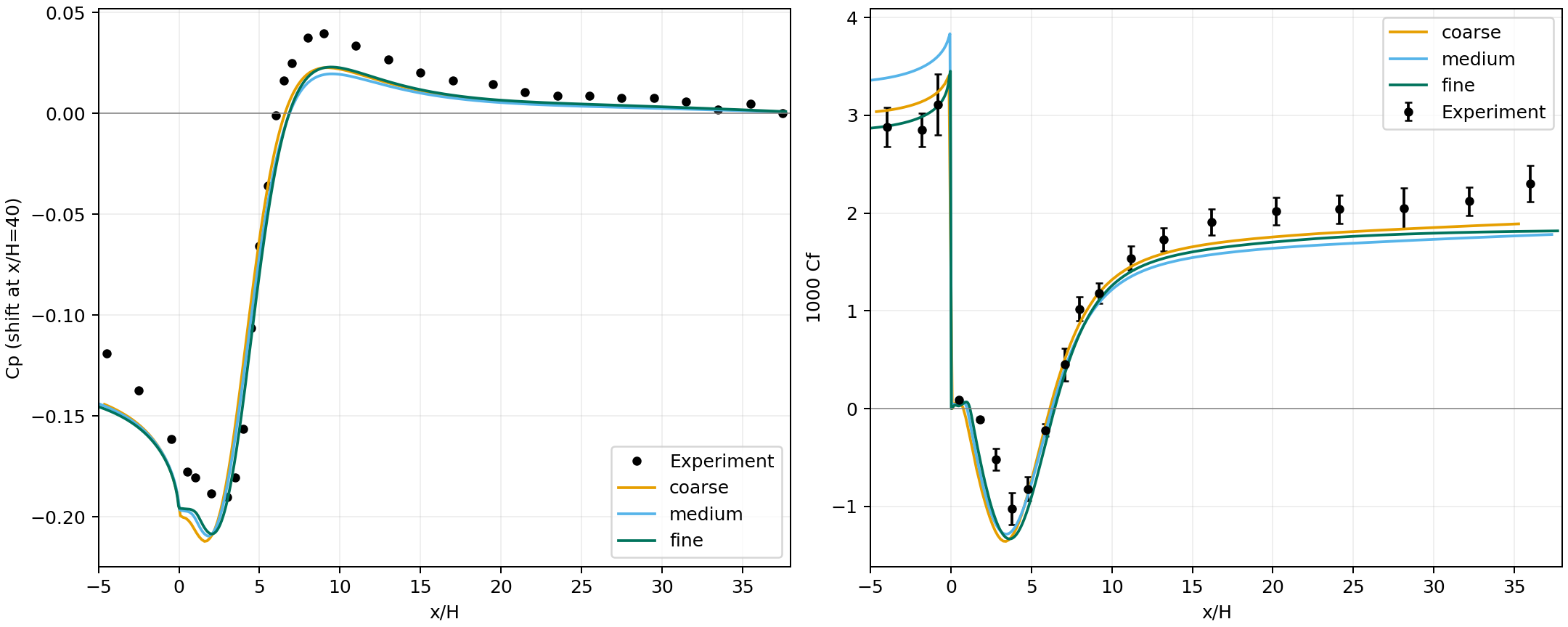
| x/H | Measured Cf | Aero Cf | Reported error ± | NASA CFL3D SSTm Cf |
|---|---|---|---|---|
| 1.804 | -0.000110 | -0.000519 | 0.000019 | -0.000366 |
| 20.196 | 0.002020 | 0.001706 | 0.000141 | 0.001838 |
| 35.994 | 0.002300 | 0.001815 | 0.000184 | 0.001977 |
Persistent downstream bias
The calculation gives more-negative wall shear in the separation region and too little positive friction after reattachment. Near x/H = 36, friction is about 21% low against a listed experimental error of ±8%.
A model contribution is plausible
Interpolating NASA’s independent CFL3D SSTm reference onto these same 20 measurements gives 7/20 inside the listed errors. It shows a related bias. That reference uses another implementation and a low-Mach, quasi-steady compressible setup; it is supporting evidence, not an identical controlled test of our OpenFOAM model.
Numerical error is still present
Mesh and near-wall treatment have not been isolated. At the measured locations, the largest final three-snapshot Cf range is 1.360e-5, much smaller than several observed misses. This supports persistent bias, while the unmet residual target prevents a complete numerical qualification.
Controlled mesh, near-wall and inflow comparisons are needed to separate these effects. This benchmark does not establish that SST alone caused all the error.
REPRODUCIBLE SETUP
What actually ran.
| Reference | Driver & Seegmiller (1985), AIAA Journal 23(2), 163–171; zero upper-wall divergence case; NASA-curated experimental data. |
|---|---|
| Operating point | H = 0.0127 m; Uref = 44.2 m/s; corrected ReH = 36,000; ν = 1.55927778 × 10⁻⁵ m²/s. |
| Domain | x/H = −130…50; upstream height 8H, downstream height 9H; viscous walls begin at −110H; one empty spanwise cell. |
| Execution | OpenFOAM Foundation 10, build 10-c4cf895ad8fa; CPU; simpleFoam; kOmegaSST; incompressible steady RANS. |
| Wall treatment | Spalding nut wall function and omegaWallFunction. Fine lower-wall sampled y+ mean 2.23, maximum 7.64; wall-resolution suitability is not automatically established by these values. |
| Inlet turbulence | 0.061% intensity; νt/ν = 0.009, following NASA’s SST comparison convention. |
| Numerics | Limited linear gradients; linearUpwind velocity; upwind k and ω; fixed schemes and relaxation across the three meshes. |
| Iterations | Coarse 1,500; medium 1,800; fine 2,000 followed by a 1,500-iteration continuation, for 3,500 total. SIMPLE iterations are not physical seconds. |
The inlet amplitude was conditioned once using an upstream-only run, then fixed at 41.62491363497 m/s for all meshes. No downstream measurement was fitted. The fine run’s actual upstream reference speed is 44.08694 m/s, -0.256% from the target. Remaining profile-shape differences contribute uncertainty.
All differences are CFD minus experiment. Velocity normalization uses the fixed measured Uref, not a per-mesh fitted denominator. Cp = 2(p − p at 40H)/Uref² with kinematic pressure; Cf = −2τx/Uref² using OpenFOAM’s inward-normal wall-stress convention. Linear interpolation maps CFD samples onto measurement coordinates. Reattachment is the Cf zero crossing after the main reverse-flow minimum.
RMSE is unweighted over published points. The report compares mean u/v, lower-wall Cp/Cf and reattachment; it does not compare the published Reynolds stresses or triple moments. Compressibility, three-dimensional effects and full experimental uncertainty are not separately quantified. The original article’s full text was unavailable from NTRS; the primary metadata, NASA case instructions and numerical tables were reviewed.
SETTLING AND OPEN GATES
A completed run is a separate claim from validation.
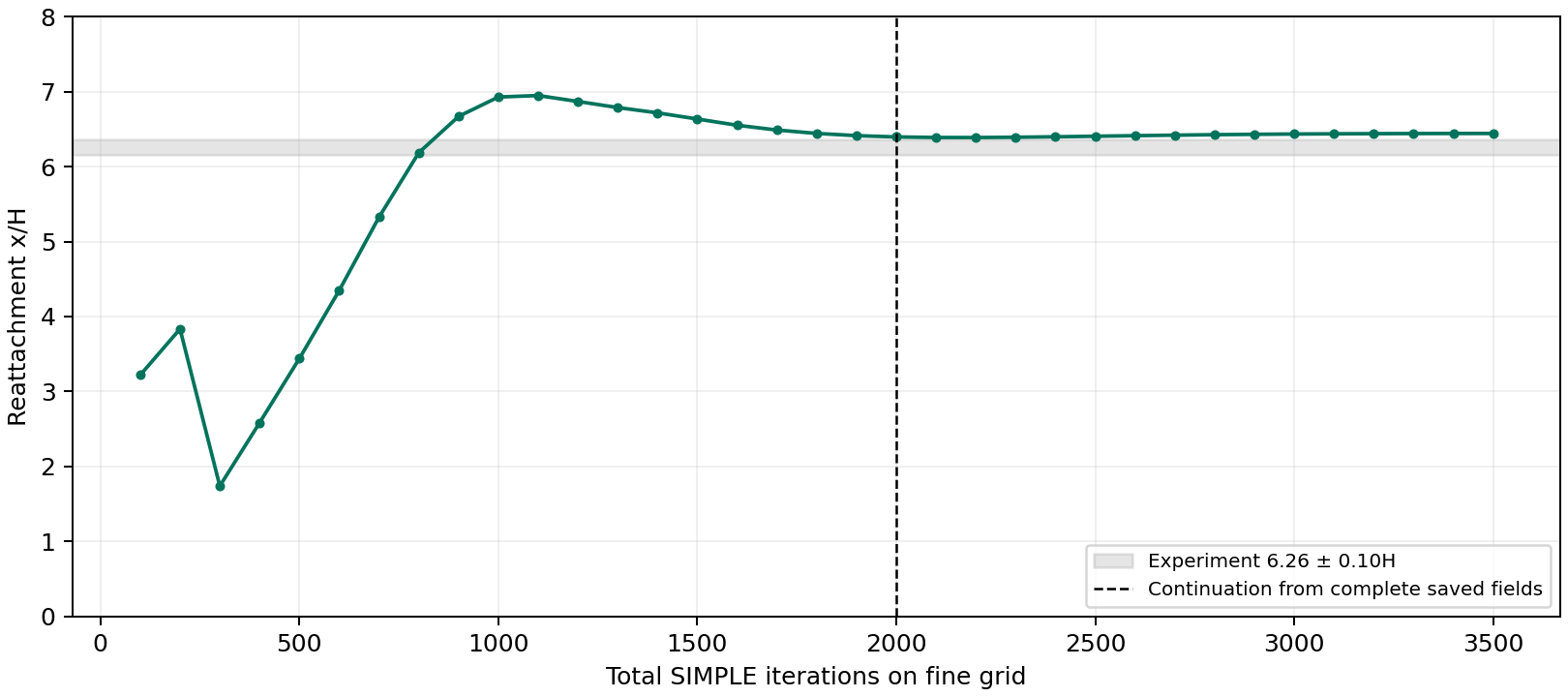
The initial fine warm start transferred only wall diagnostics because the medium run’s latest retained time had no complete U/p fields. Its primary fields therefore started uniformly. The continuation used the complete fine-grid checkpoint at iteration 2,000. A guard now requires complete solved fields for future mapped starts. The medium comparison retains valid sampled data, although its final complete volume fields were not collected.
A necessary imported-case fix preserved the supplied polyMesh and still ran checkMesh. All three meshes passed checkMesh; maximum non-orthogonality was zero. All 37 existing pipeline tests passed, and an independent arithmetic audit recomputed the pointwise differences, RMSEs and raw-stress reattachment root. Those checks establish execution and arithmetic evidence, not physical accuracy.
Fine final initial residuals include p = 1.022e-3 and k = 8.941e-5, above the selected 10⁻⁶ criterion. Fine inlet/outlet flux imbalance is 1.615e-8 as a fraction of inlet flow. Small imbalance does not establish solution accuracy.
AI AND NUMERICAL PROVENANCE
OpenAI 6.1 High assisted the workflow.
Model attribution: OpenAI 6.1 High, as supplied by project owner Alex Blythe. The retained runtime artifacts do not independently capture the model identity.
The model assisted case preparation, Aero pipeline orchestration, postprocessing, diagnosis and documentation. OpenFOAM produced the numerical CFD predictions. This is one AI-assisted engineering workflow execution, not a controlled comparison of language models or evidence that an LLM itself solved the flow equations.
OPEN EVIDENCE
Read the values. Replay the cases.
The bundle contains retained case inputs, mesh files, solver logs, sampled results, complete retained fine-grid fields, public reference data and comparison scripts. Run checkMesh and simpleFoam on a writable copy of each case_input. The fine checkpoint is already mapped into its starting fields. The README records the 2,000 + 1,500 continuation and the medium-field retention limitation.
The package is restricted to this public experiment. Private Aero toolkit modules, credentials, employer information and live-service configuration are excluded. Hashes establish artifact identity, not scientific correctness.
Primary sources
- Driver & Seegmiller, “Features of a Reattaching Turbulent Shear Layer in Divergent Channel Flow,” AIAA Journal (1985); NASA publication record.
- NASA experimental case and measurements; boundary geometry and grids.
- NASA SSTm reference and steady-convergence qualification; NASA dimensional operating point.