Reconstructed geometry
One periodic hot/cold channel pair, 0.24 m active length, semicircular 2.5 mm channel diameter, and declared corrugation assumptions. This is independent OpenCASCADE geometry, not author CAD.
AERO / HX-S01 - SYNTHETIC REPLACEMENT
SOURCE-INFORMED / NOT BLIND / NOT EXPERIMENTALLY VALIDATEDThe publication-targeted path did not establish a pointwise experiment matched to the reconstructed solver condition. With the owner's approval, HX-S01 uses a real PCHE study for configuration context, labels missing inputs as assumptions, and tests a bounded analytical-plus-OpenFOAM workflow. It does not invent experimental measurements.
Samarmad and Jaffal (2023) provide a real two-way-corrugated PCHE configuration reference. The reconstructed 293 K case has no established pointwise experimental match, and the source gives 290 K in another passage. Structural test truth and complete structural inputs are also absent. The publisher says data are available on request, but a matched pointwise package was not obtained for this execution. We therefore define a runnable synthetic case and mark each completion instead of inventing measurements or scoring agreement; a custodian-led request can reopen HX-B01 later.
Seo et al. (2015) provides additional water-PCHE method context, and NIST reference correlations ground nominal liquid-water properties. These references inform setup and property selection, not a hidden answer or validation target.
The public package contains Aero-authored inputs and calculated outputs, not the cited papers, figures, tables, or copied passages. The source-use record identifies the consulted author-uploaded Samarmad copy as CC BY-NC-ND 4.0 and records attributed noncommercial reference use; commercial reuse was not cleared. This is not legal advice.
All three OpenFOAM Foundation v10 chtMultiRegionFoam grids reached the original 250-iteration horizon. A normal end marker does not establish convergence. The predeclared residual target failed on every grid; medium-to-fine pressure-drop changes were 22.2% cold-side and 22.6% hot-side against a 5% limit. Mass and energy balances met their limits, and the retained basic checkMesh gate passed.
| Metric at 250 iterations | Coarse | Medium | Fine | Disposition |
|---|---|---|---|---|
| Cells | 494,670 | 1,003,677 | 2,770,939 | Three levels executed |
| Maximum final residual | 2.14e-4 | 5.77e-6 | 6.70e-6 | FAIL; limit 1e-6 |
| Mass imbalance | 0.067% | 0.090% | 0.062% | Within 0.5% limit |
| Hot/cold energy imbalance | 3.67% | 2.49% | 1.50% | Within 5% limit |
| Cold-side pressure drop | 1,340.9 Pa | 1,407.9 Pa | 1,808.9 Pa | 22.2% medium-to-fine; FAIL |
| Hot-side pressure drop | 1,319.4 Pa | 1,393.7 Pa | 1,800.9 Pa | 22.6% medium-to-fine; FAIL |
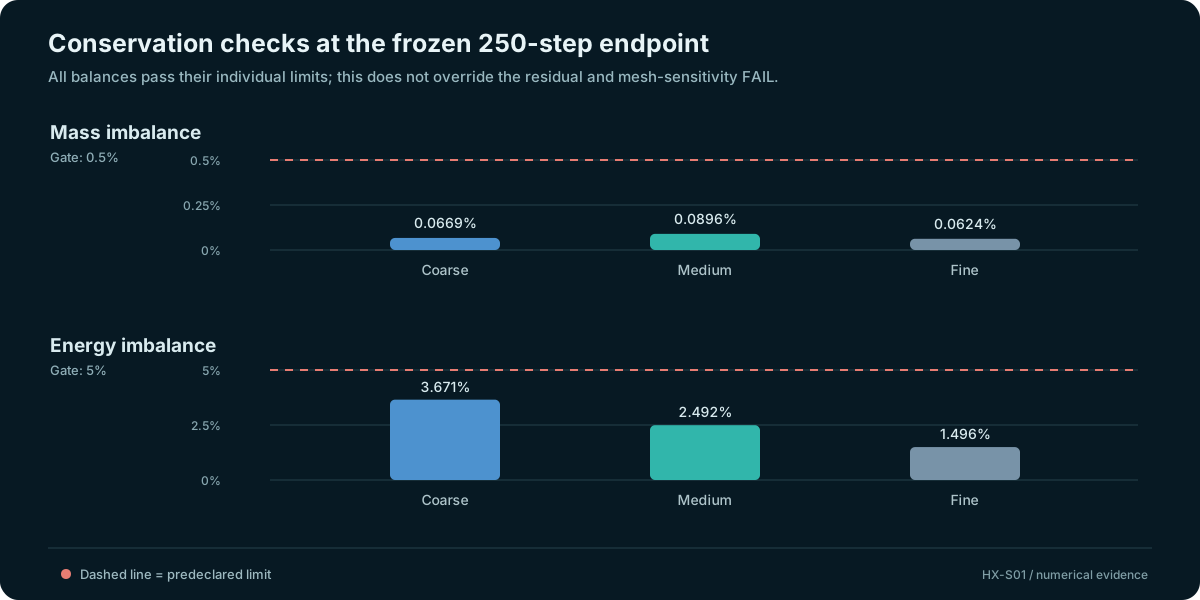
Mesh-record clarification: a generated setup manifest says all meshes fail an additional frozen quality criterion, but the frozen acceptance file specifies the per-region checkMesh gate and the retained logs and assessment say Mesh OK. No separate frozen limit supporting that sentence was found, so it is treated as unsupported and the original file is preserved. The medium hot-fluid log records one face at 70.103 degrees while still reporting Mesh OK. This does not change the overall numerical FAIL.
All three grids reached iteration 1,000 under the original numerical settings. Each still misses the residual limit; heat-duty snapshots rose by about 196-203% from iteration 250. The fine case resumed from its archived iteration-275 field without changing mesh, physics, or numerical settings. These diagnostic extensions do not change the frozen baseline.
| Grid | Endpoint | Final max residual | Hot / cold ΔP | Hot duty | Cold duty | Mass / energy balance |
|---|---|---|---|---|---|---|
| Coarse | 1,000; normal end | 2.848e-4; FAIL | 1,318.63 / 1,342.31 Pa | 6.661 to 20.134 W (+202.3%) | 6.915 to 20.638 W (+198.5%) | 0.067% / 2.443% |
| Medium | 1,000; normal end | 1.809e-6; FAIL | 1,394.24 / 1,406.88 Pa | 6.844 to 20.428 W (+198.5%) | 7.019 to 20.799 W (+196.3%) | 0.088% / 1.782% |
| Fine | 1,000; normal end after resume | 1.981e-6; FAIL | 1,794.72 / 1,802.36 Pa | 6.722 to 20.097 W (+199.0%) | 6.824 to 20.533 W (+200.9%) | 0.063% / 2.123% |
At 1,000, fine-to-medium pressure-drop differences are 28.7% hot-side and 28.1% cold-side. Heat-duty snapshots are more closely grouped, but this quantity-specific agreement does not cure residual failure or pressure-drop disagreement. The 1,000 extension is diagnostic only, not a newly frozen gate or validation claim.
One periodic hot/cold channel pair, 0.24 m active length, semicircular 2.5 mm channel diameter, and declared corrugation assumptions. This is independent OpenCASCADE geometry, not author CAD.
Counter-current water-to-water; 323 K hot inlet, 293 K cold inlet, and plus/minus 0.246 m/s. Constant water properties are nominal near 308.15 K; temperature dependence, headers, and collectors are omitted.
A straight, fully developed semicircular-duct estimate gives Re about 519, hydraulic diameter about 1.528 mm, and pressure drop about 576 Pa. An idealized straight-channel duty screen gives 27.5-30.9 W per pair. Neither is an uncertainty band or target for corrugated CFD.
No experiment comparison, PCHE-specific structural FEA, material-strength assessment, wall-resolution qualification, or design readiness. Those remain NOT EVALUATED or NOT ESTABLISHED.
HX-S01 demonstrates that Aero's existing case tooling supported a declared source-informed case through analytical screening, parametric geometry, three-region OpenFOAM CHT, conservation accounting, and numerical-gate evaluation. The work was Codex-supervised and human-orchestrated; it did not test whether Aero's local conversational model independently plans, configures, or recovers a case. The result is a numerical failure, not physical validation. The useful pipeline evidence is that its gates rejected an unsettled, mesh-sensitive result rather than reporting success.
The earlier publication-blind HX-B01 attempts remain unchanged and stopped before solver execution. This synthetic study is separate; it does not retroactively resolve HX-B01 or close HX-B02 through HX-B05 or HX-D01.
The evidence register identifies retained local artifacts by SHA-256. Hashes establish file identity relative to the register; they do not prove scientific validity or provide a trusted timestamp. The public page hosts the report and summary records, not the raw solver logs or mesh binaries.