Wall-function treatment
Maximum y+ 12.67
Area inside selected screen 0.0%
Near-wall screen FAILSignificant active-field residuals remain at the iteration limit.
VERIFICATION BENCH · REV 1.0
Inspect the cases that pass, the controls that fail, and the evidence that tells them apart.
01 / LAMINAR PIPE · Re 200
The analytical target is 0.64 Pa. Three grids pass the 2% allowance; two negative controls do not.
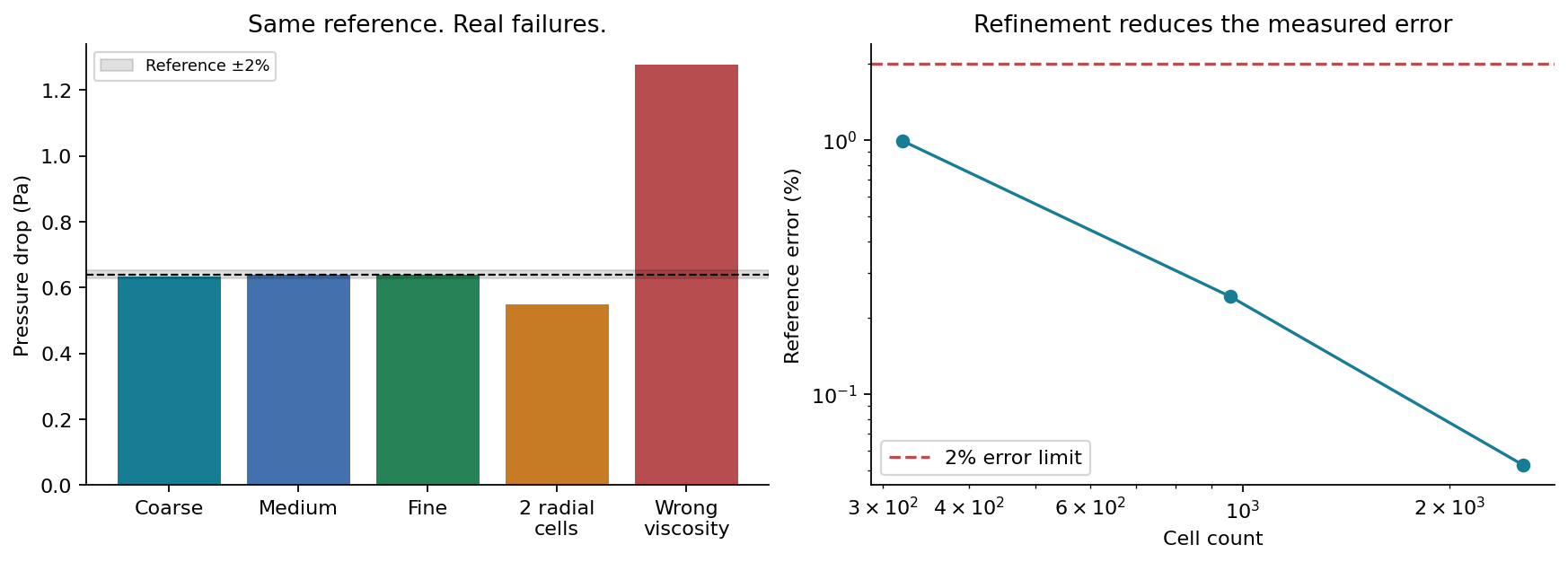
| Case | Cells | Δp / Pa | Error | Gate |
|---|---|---|---|---|
| coarse | 320 | 0.633629 | 0.996% | PASS |
| medium | 960 | 0.638447 | 0.243% | PASS |
| fine | 2,560 | 0.639663 | 0.053% | PASS |
| underresolved | 80 | 0.550638 | 13.963% | FAIL |
| wrong viscosity | 960 | 1.277473 | 99.605% | FAIL |
All five recorded outcomes are shown in the table above. Interactive gate selection is available on the full bench page when JavaScript is enabled.
D = 10 mm, L = 100 mm, bulk speed = 0.02 m/s, density = 1000 kg/m³, kinematic viscosity = 10⁻⁶ m²/s. Pressure is a fitted interior gradient × full length, not entrance loss. Darcy f = 64/Re = 0.32; Fanning f = 0.08.
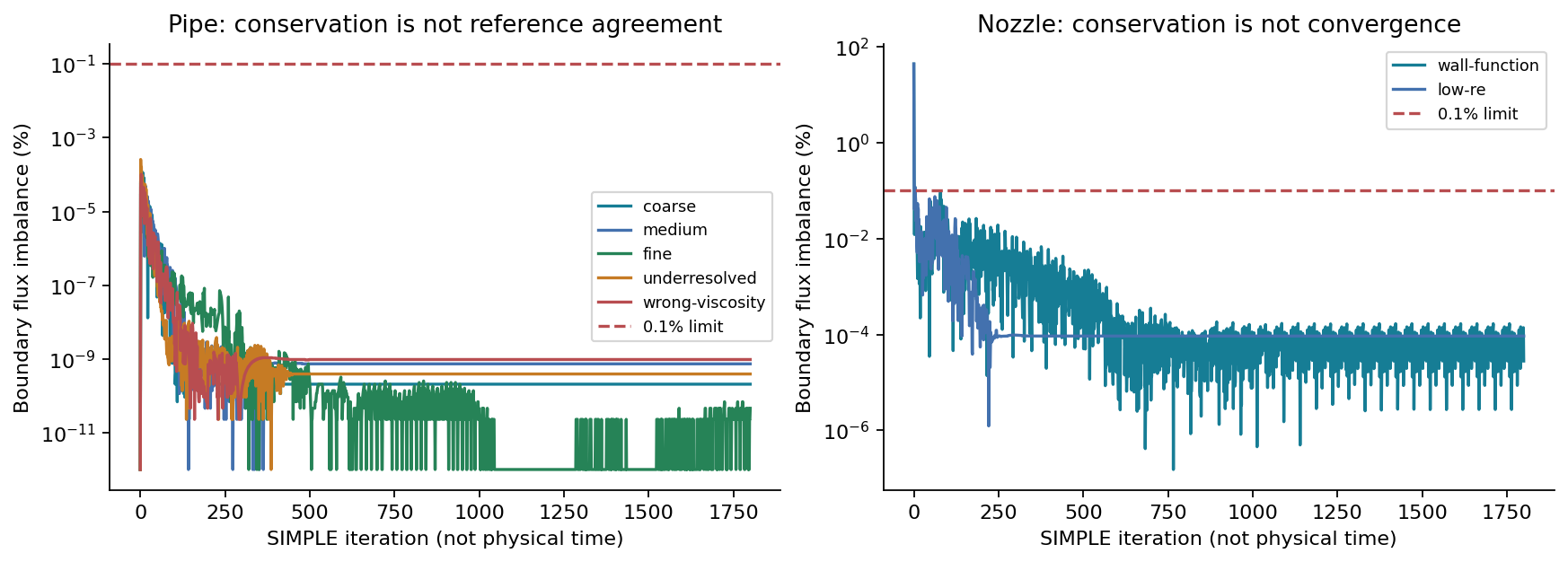
The first gate rejected an ill-conditioned residual in an essentially zero transverse velocity. Criteria 1.1 introduced an explicit component-to-bulk scale check, then all seven CFD cases were rerun. This is a disclosed post-diagnostic correction, not a blind preregistration. Original diagnostic summaries remain in the archive. Pipe runs reached the fixed iteration limit; the explicit scale-aware acceptance checks are separate from the built-in stopping flag.
The underresolved case has two radial cells. The wrong-viscosity deck doubles viscosity without changing the original requirement. Their errors are measured, not assigned by a scripted FAIL label.
02 / NEW LOW-MACH NOZZLE DIAGNOSTIC
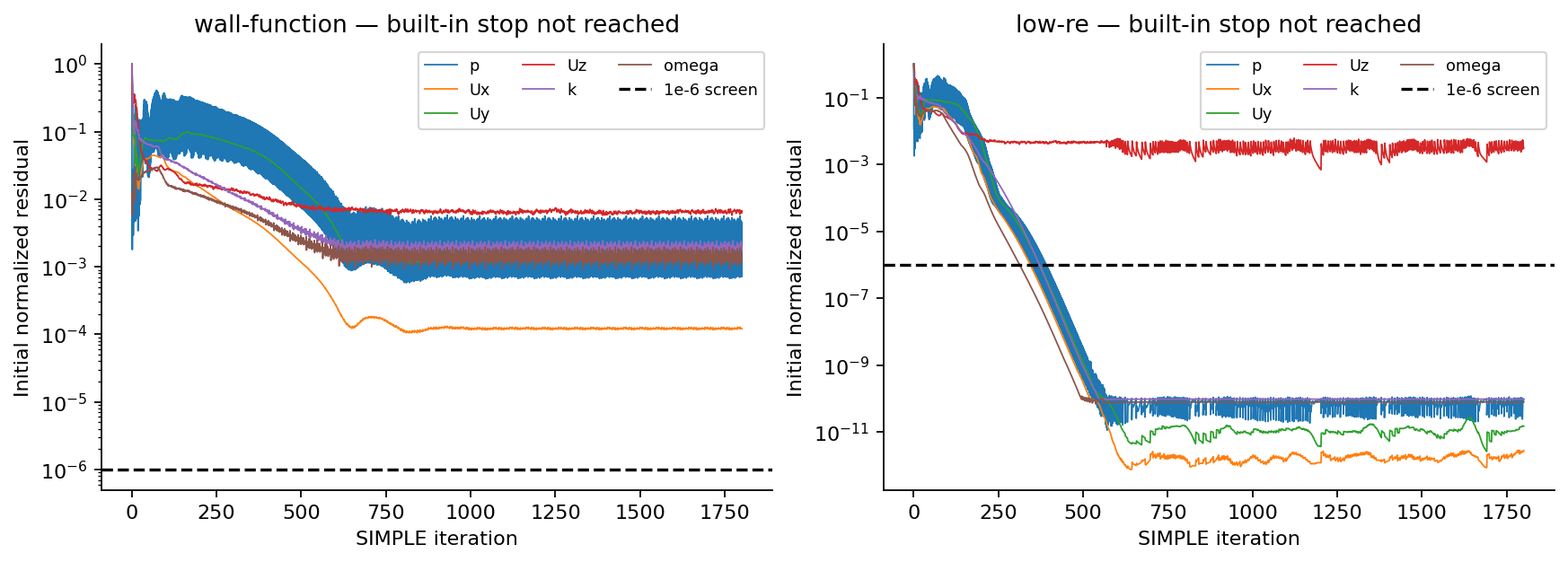
Same 1,920-cell grid, same SST closure, different near-wall treatments. Both fail the selected y+ area screen. Their residual behavior differs; neither reaches the built-in stop. This does not revalidate the older wall-refinement-v6 case.
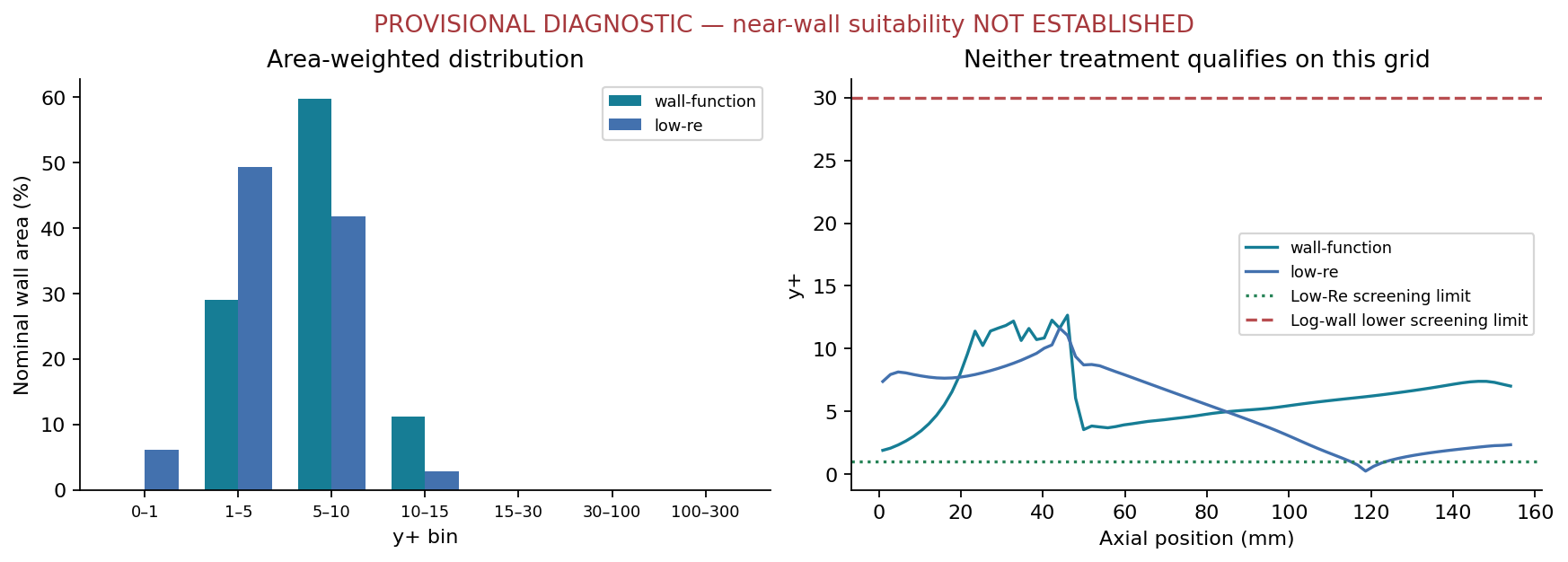
Maximum y+ 12.67
Area inside selected screen 0.0%
Near-wall screen FAILSignificant active-field residuals remain at the iteration limit.
Maximum y+ 11.64
Area inside selected screen 6.2%
Near-wall screen FAILActive-field residuals are small; the negligible transverse component prevents the built-in stop.
Bench screens: 95% of nominal wall area at 30 ≤ y+ ≤ 300 for the log-wall treatment; 95% at y+ ≤ 1 for direct low-Re walls. These are selected requirements, not universal validity laws. The two treatments may evaluate effective wall scaling differently; the comparison is not an independent wall-shear validation.
Direct low-Re pressure, in-plane velocity, k and omega residuals are below 10⁻¹⁰. Its normalized Uz residual remains about 0.003 despite max |Uz| / inlet speed being only 5.12 × 10⁻¹³. This is different from the wall-function case's significant active-field residuals. Both still fail near-wall suitability.
Inlet Re ≈ 5,333, no transition model, no independent nozzle reference. Direct-wall omega uses approximate first-cell height. The report explains what must be established before a performance prediction can be accepted.
03 / IMPORTED STEP · FILLET + INTERSECTING PORTS
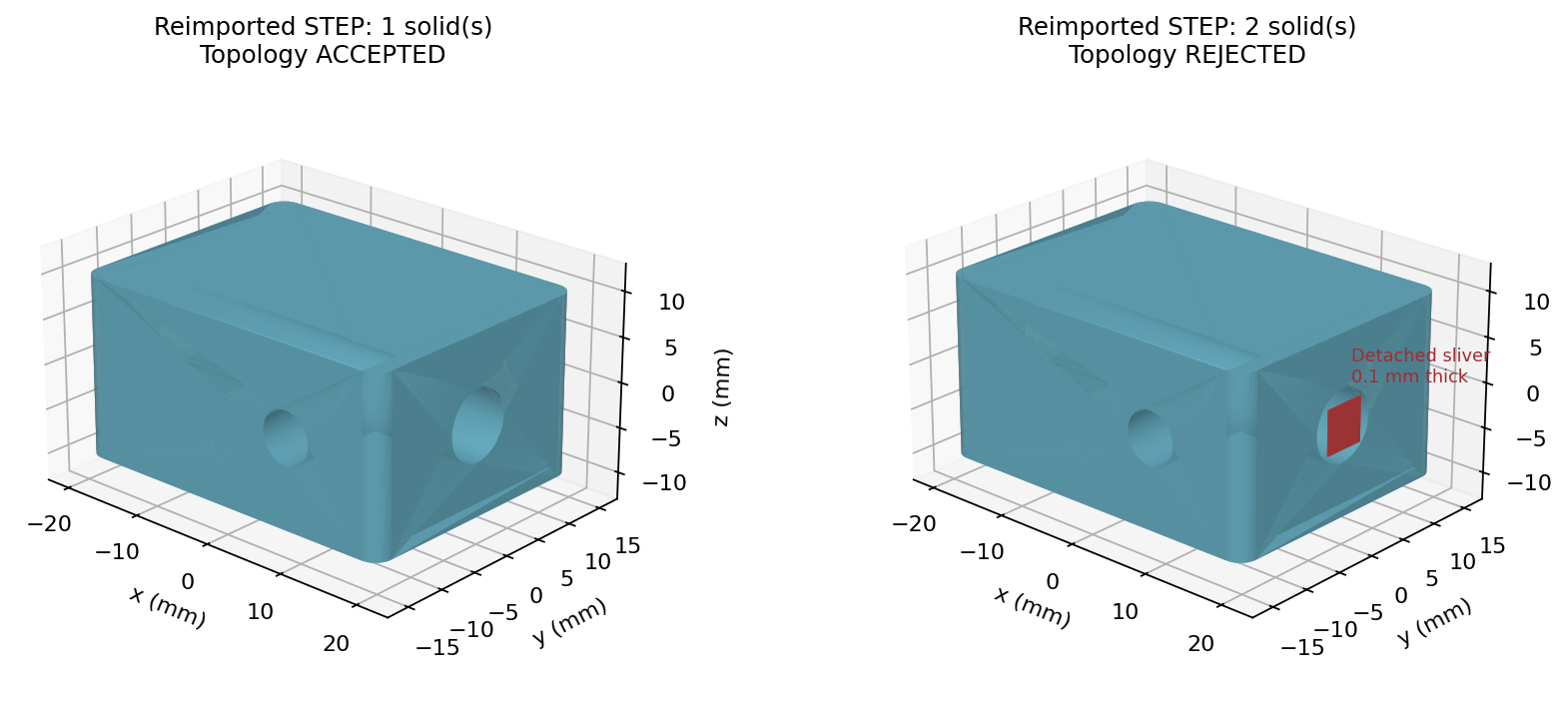
One valid connected solid. Physics, fluid region and boundary assignments remain missing: overall readiness is not established.
Two connected components violate the single-solid contract. Quarantined for review before mesh or solve. Multiple solids can be intentional elsewhere; this gate does not silently delete them.
04 / VERSIONED, DOWNLOADABLE EVIDENCE
Seven new OpenFOAM runs, two STEP imports, and five retained CalculiX solves. 295 hashed source and evidence files. These curated downloads have no 48-hour job expiration.
OpenFOAM Foundation 10; CalculiX 2.20; Gmsh 4.15.2; CadQuery 2.7.0; OCP 7.8.1.1. The archive includes original decks, meshes, logs, final fields, criteria and an offline verifier. Local image IDs identify the executed environment; they are not public image download URLs.
python source/audit.py .
Run this after extracting the archive. Copy decks to a new scratch directory before rerunning. Complete reproduction instructions · Machine-readable results
The CalculiX subset contains the three-level pressure tube, a ported-tube fine solve and a thermal-gradient fine solve, recorded September 12. Original receipts preserve failed and incomplete gates. They are not five new solves.